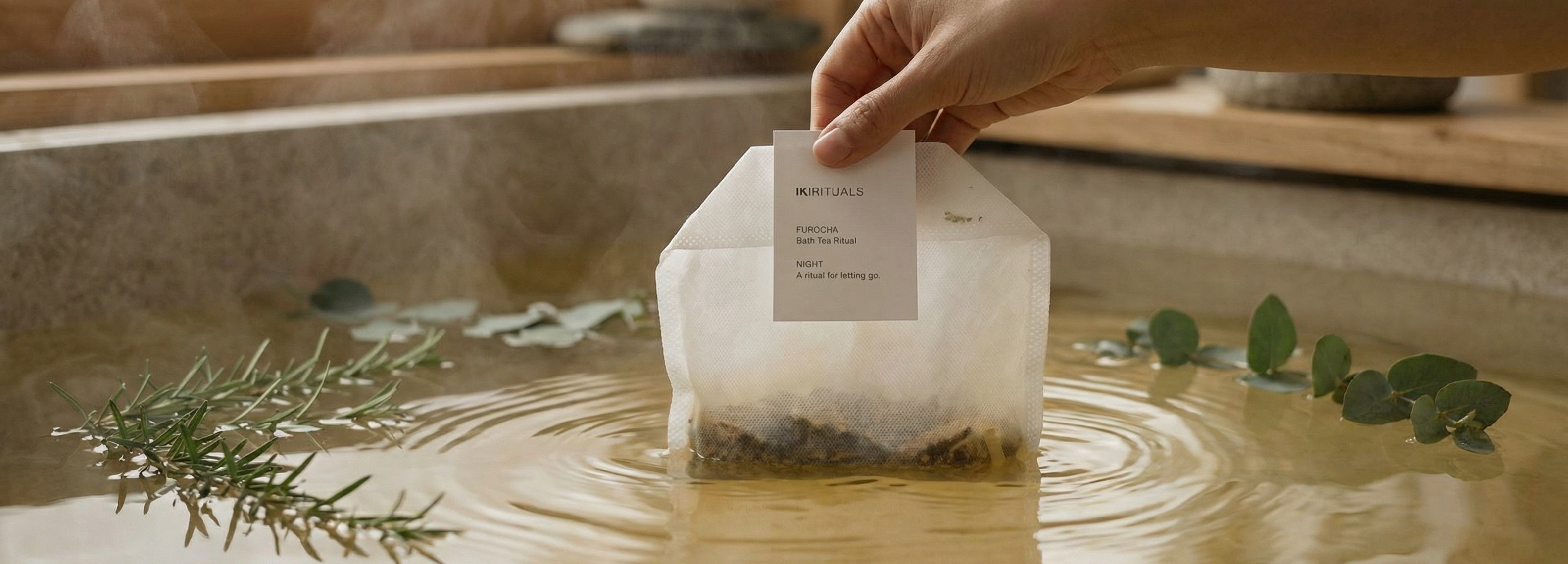
Article: A Manifesto on Ritual

A Manifesto on Ritual
About rituals and their function
Rituals have existed in all cultures where people have lived together. They have often been associated with water, warmth, and plants. Not primarily as decoration or symbolism, but as practical ways to mark transitions.
Transitions between work and rest.
Between day and night.
Between activity and stillness.
Rituals have served as structures for such shifts.
The role of bathing in Japanese tradition
In Japan, bathing has historically had a clear social and physical function. The Onsen culture emerged around natural hot springs, where mineral-rich water was regularly used as part of daily life.
Bathing was not primarily a way to escape everyday life, but a way to restore the body. Silence, order, and repetition were central elements. The body was immersed in water, the warmth was allowed to work, time was allowed to pass.
Plants and natural additives were often used in bathing contexts, especially in connection with the seasons. Citrus fruits, herbs, and leaves were not used for effect, but to reinforce the rhythm of the bath and its connection to nature.
Warmth and cold in Nordic practice
In the Nordic countries, the sauna has had a similar function. It has been a place for cleansing, rest, and community, but also for silence. The sauna was not only used for hygiene, but as a space where the body was allowed to return to a neutral state.
Warmth was often followed by cold. Bathing in lakes, snow, or ice water was a natural part of the experience. The alternation between warm and cold created clear boundaries in the experience, but without demands for performance.
Here too, repetition was important. The same movements. The same order. The same place.
The difference between habit and ritual
A habit aims for efficiency.
A ritual aims for presence.
Rituals are not repeated to save time, but to give time a form. They don't have to be complex, but they require attention. When rituals lose their structure, they quickly become functions.
In a modern context, many rituals have been reduced to methods. Bathing becomes recovery. Stillness becomes a goal. Self-care becomes a project.
This changes the original role of the ritual.
Rituals as non-instrumental actions
Rituals are not meant to produce results. They are actions without direct returns. Their value lies in the performance itself, not in the effect.
This is also why rituals are often perceived as slow. They are not optimized. They are intentionally repetitive.
This slowness has historically served as a counterweight to the demands of everyday life.
About Ritual Notes
Ritual Notes is an archive for reflections on the role of rituals in human life. The texts are based on historical practices and contemporary observations, without claiming to offer solutions or instructions.
Here, rituals are treated as cultural structures rather than personal tools.
We publish infrequently.
Intentionally so.
IKI Rite