Article: Ritual and Repetition
Ritual and Repetition
Rituals rarely arise through variation.
They arise through repetition.
It is not novelty that gives the ritual its value, but recurrence. The same action. The same order. The same time. It is through this recognition that the ritual fulfills its function.
In human cultures, rituals have always been connected to transitions. Not to performance, but to shifts. Between activity and rest. Between day and night. Between one state and another.
Repetition makes transition possible.
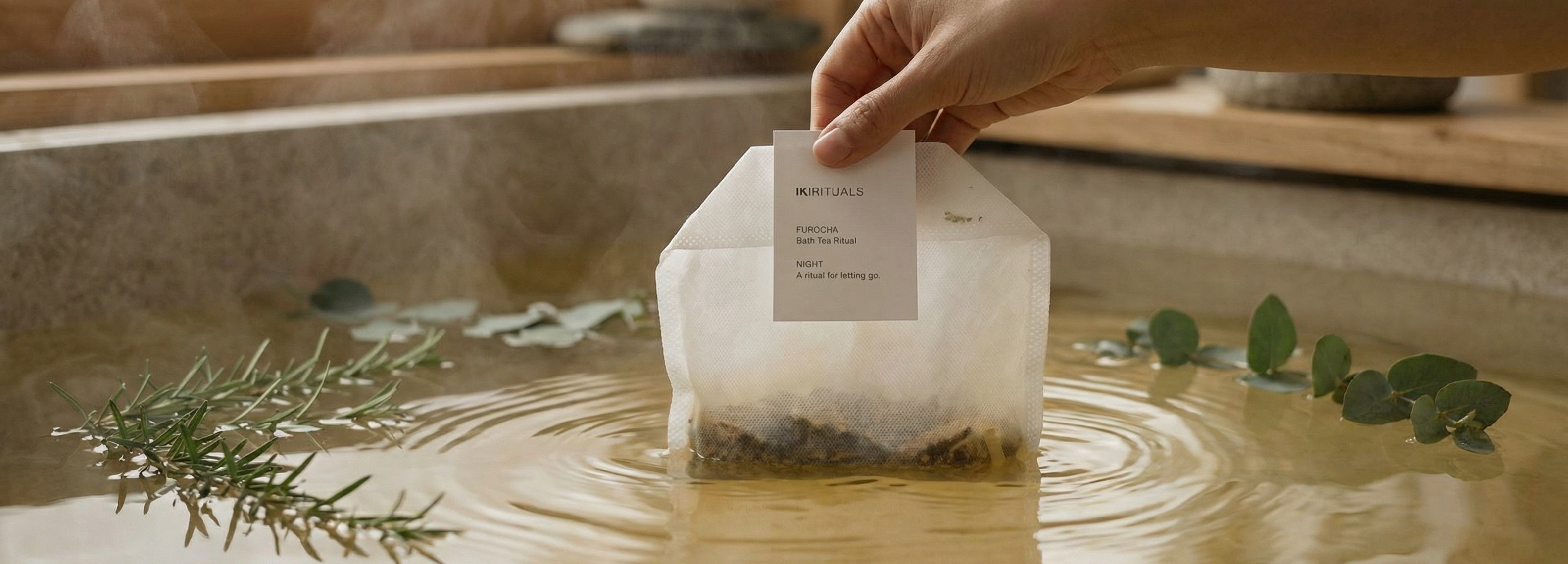
In Japan, bathing has long served as such a structure. Immersing the body in warm water is not a spontaneous act, but something that occurs in a specific way. One washes before. One descends slowly. One sits still.
There is an order.
And it is repeated.
Through repetition, the bath becomes more than hygiene. It becomes a way for the body to let go of what preceded it. The warmth is allowed to work. Breathing slows down. Time takes on a different pace.
When plants have been used in the bath – citrus in winter, herbs on special occasions – it has rarely been about effect in the modern sense. Rather about rhythm. About letting nature's cycles become part of the bath's.
In the Nordics, warmth has played a similar role. The sauna is not for variation, but for repetition. The same movement. The same heat. The same stillness. Often followed by cold.
The alternation between hot and cold creates clear boundaries in the body. But it is the repetition that makes the experience comprehensible. The body knows what is coming. It does not need to negotiate.
That is why many return to the same place. The same lake. The same sauna. The same evening of the week.
Repetition sometimes has a bad reputation. It is associated with monotony or routine. But the repetition of ritual is of a different kind.
A routine is done to become more efficient.
A ritual is done to become present.
The form of ritual is often explicit. Slow. Seemingly unnecessary. But it is precisely this that distinguishes it from the flow of everyday life. It does not break through pace, but through structure.
When the action is the same every time, attention is freed. One does not need to choose. One does not need to improve. One only needs to perform.
In our time, many rituals have lost their form. They have become functions. Bathing becomes recovery. Stillness becomes a goal. Self-care becomes yet another area to succeed in.
When ritual is reduced to effect, its value disappears. Repetition then becomes something to be optimized away, rather than embraced.
But historically, rituals have worked precisely because they were not optimized. They were slow enough to give space to the body. Similar enough each time to create security.
Repetition is therefore not an obstacle to ritual.
It is its prerequisite.
It is by doing the same thing again that ritual ceases to be an attempt and becomes something one returns to. Not because it promises a result, but because it creates a state.
A calm ending.
An interlude.
A transition.
IKI Rite